

The London School of Economics and Political Science hosted the international conference “AI and the Future of Social Welfare: Recent Developments and Future Prospects”  on June 4–5. The event brought together scholars and practitioners from around the world to examine contemporary social policy challenges in the context of the rapid expansion of artificial intelligence and its growing impact across multiple domains of human activity.
Participants were welcomed by the co-chairs of the preparatory committee, representing the London School of Economics, and the University of California, Berkeley. The conference was also formally welcomed by Dr. Sergei Zelenev, President of the International Council on Social Welfare (ICSW), speaking on behalf of the organization.
The preparatory process included the submission of papers on the conference theme, which were reviewed by the organizing committee. Selected contributors were then invited to present their work. The resulting programme was notably broad in scope, bringing together diverse disciplinary perspectives and professional approaches—an aspect widely seen as one of the conference’s key strengths.
The agenda covered a wide range of topics, including governance of AI systems, AI in qualitative research, AI in education, AI in service delivery, AI as a policy actor: rethinking expertise and deliberation in public welfare, and ethical considerations in the use of AI in social welfare, among others.
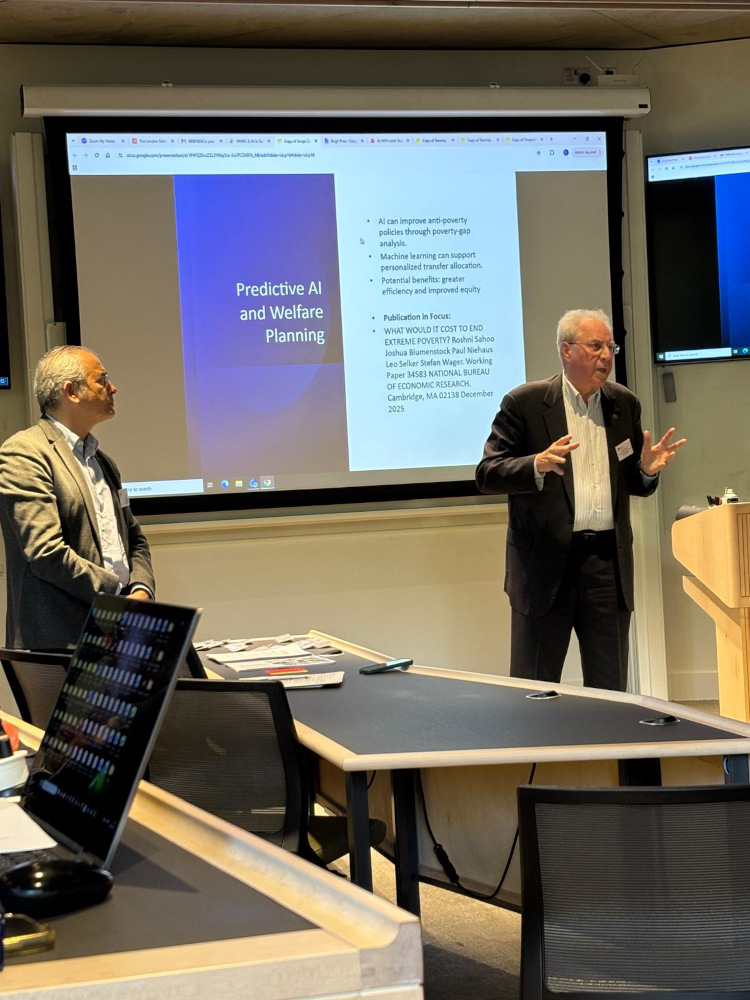 Dr. Sergei Zelenev delivered a presentation entitled “AI as a Mediating Force: Advancing Pro- Social and Integrated Welfare Policies for the 21st Century.” Professor Antonio López Peláez, ICSW Executive Director and Professor at UNED in Madrid, together with Professor Gloria Kirwan of RCSI Dublin, presented findings from their study “AI as a Pedagogical Tool: Fostering Critical Thinking in Social Work Education.”
The discussions reflected both the opportunities and risks associated with the rapid diffusion of AI applications. They also highlighted growing concerns at national and institutional levels regarding transformations in education, potential labour market disruptions, and broader social impacts that remain difficult to anticipate. Ethical questions surrounding the use of AI in social welfare systems featured prominently throughout the conference deliberations.


