

Featured Article From Global Newsletter - November 2025
by Sergei Zelenev, ICSW President
Introduction
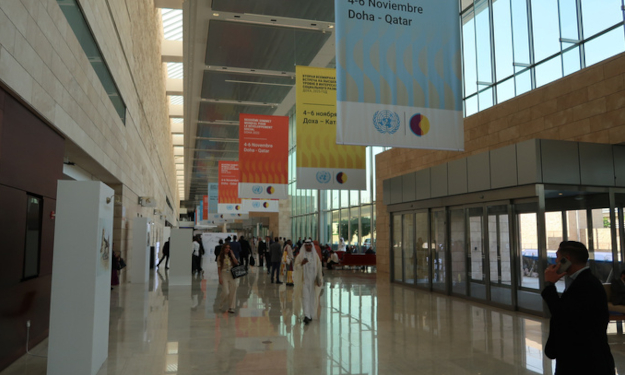
The discussion on integrated social policy featured prominently in ICSW’s engagement at the Second World Social Summit, reflecting months of sustained analytical preparation and strategic dialogue. The preparatory phase for the ICSW- sponsored Solutions Session, held in Doha, extended over two months—a substantial investment of time justified by both the political significance of the Summit and the opportunity it offered ICSW to articulate its vision before a global audience. This background work, undertaken in close collaboration with partners from the International Association of Schools of Social Work (IASSW), International Consortium for Social Development (ICSD), and the International Federation of Social Workers (IFSW), ensured that the session was grounded in diverse perspectives and aligned with the broader professional community. The main elements of this preparatory work were distilled in a concept note circulated prior to the session.
A central focus of the preparatory process was the draft Political Declaration of the Second World Social Summit. This document, which will guide global social development efforts in the coming decade, embodies both continuity and innovation. It reaffirms the enduring priorities of poverty eradication, employment promotion, and social integration—long-standing pillars of ICSW’s advocacy—while also broadening the global agenda to address climate change, digital transformation, demographic shifts, and widening inequalities. For ICSW, the draft declaration represents both a recognition of its long-standing commitments and a renewed call to action. It highlights the urgency of universal social protection, inclusive labor markets, and multidimensional approaches to poverty; underscores the need for stronger multilateral cooperation; and stresses the vital role of civil society in shaping effective and equitable social policies.
In this evolving landscape, ICSW saw its mandate clearly: to mobilize its global network to ensure that the commitments articulated in the declaration translate into meaningful outcomes for the most vulnerable. By championing universal social protection, promoting solidarity across generations, and advocating for policies rooted in equity and inclusion, ICSW aims to transform the aspirations of the declaration into tangible progress on the ground.
Against this backdrop, the decision to focus ICSW’s Solutions Session on integrated social policy was both timely and strategic. Integrated approaches have long been a hallmark of ICSW’s analytical work and policy advocacy. Their strength lies in recognizing the structural and multidimensional nature of social problems. Poverty, for instance, is seldom a matter of income deprivation alone but is interwoven with barriers to healthcare, insecure employment, inadequate housing, and social exclusion. Fragmented, sector- specific policies often yield partial or temporary solutions, leaving underlying vulnerabilities unresolved. Integrated social policies, by contrast, acknowledge these interdependencies and seek to reinforce them through coherent strategies— linking, for example, cash transfers with access to education, health services, and active labor market measures. Such synergies reduce inefficiencies, strengthen developmental outcomes, and enhance institutional accountability.
Moreover, integrated social policy is essential for promoting equity and social justice—core dimensions of sustainable development. It offers a corrective to short-term, growth-oriented policymaking by ensuring that development gains are broadly shared and that marginalized groups are systematically included. At a time when societies face interconnected crises—from economic shocks to climate-related disasters— integrated systems of social protection, healthcare, and labor market support are indispensable for building resilience.
In addition to the Solutions Session, ICSW contributed to other key analytical efforts at the Summit, including the IASSW-led Solutions Session on universal social protection and the intergovernmental equity discussions at the Solutions Session convened by IFSW. Together, these engagements underscore ICSW’s continued leadership in shaping holistic, forward-looking approaches to social development.
The concept note for the ICSW-sponsored Solutions Session was prepared and circulated well in advance and also posted on the ICSW website. Its summary appears below.
Concept Note Summary
The concept note emphasized that while traditional pillars of social policy—poverty reduction, healthcare, education, employment, and social security—remain essential, they are no longer sufficient when addressed in isolation. Fragmented, sector-based responses struggle to keep pace with rapidly evolving societal needs. As the world confronts rising inequalities, demographic shifts, technological disruption, and the intensifying effects of climate change, the demand for integrated and holistic social policies has become urgent and unavoidable.
Integrated social policy was presented as a forward-looking framework that situates individuals and communities within a wider socio- economic ecosystem. It calls for policy coherence, cross-sectoral collaboration, and interventions that span multiple dimensions of wellbeing—economic, social, environmental, and cultural. Importantly, it recognizes the interdependence of global and local realities and underscores the need for multilevel governance capable of linking national strategies with local implementation.
The concept note also highlighted the central role of the social service workforce and the importance of partnerships across governments, civil society, academia, and communities. It reaffirmed that integrated approaches are critical not only to addressing complex risks but also to expanding human capabilities, strengthening social cohesion, and ensuring inclusive and sustainable development.
Session Highlights
Moderated discussions underscored three central themes:
- The continued relevance of integration. Despite significant policy innovation over recent decades, siloed approaches persist. Panelists strongly argued for renewed commitments to coherence, coordination, and long-term institution-building.
- The need for human-centered, capability- enhancing approaches. Integrated social policies should empower people, particularly marginalized groups, by expanding access to services, opportunities, and social protection.
- The essential role of the social service workforce. Effective integration depends on a well-resourced, professionalized, and respected workforce capable of coordinating across sectors and responding to multidimensional needs.
Speakers also emphasized the importance of evidence-building, research partnerships, participatory policymaking, and community- engaged approaches to ensure that integrated policies are context-specific, culturally grounded, and sustainable.
Gloria Kirwan (ICSW), moderating the session, concluded by emphasizing that the lessons presented offer valuable guidance for balancing the multiple policy pillars necessary for sustainable development and ensuring coherence across all levels of governance.
Composition of the Panel
Open to ICSW partners, the composition of the panel reflected ICSW’s commitment to presenting both scholars and practitioners addressing pertinent issues at conceptual and country-specific levels. (Detailed biographical notes of the participants, in order of appearance, are provided below.)
- Leila Patel (IASSW/ICSD)
- P.K. Shajahan (ICSW)
- Lauren Graham (IASSW/ICSD)
- Ronald Wiman (ICSW)
- Sergei Zelenev (ICSW)
- Mahesh Chougule (ICSD)
- Patricia Welch Saleeby (IFSW)
- Moderator: Gloria Kirwan (ICSW)
The presentations addressed both overarching themes and country-specific experiences, positioning integrated social policy as a central driver of sustainable development that complements the traditional economic, social, and environmental pillars. The following review reflects the speakers’ statements. Every effort has been made to preserve the authentic voice of the panelists while ensuring a balanced presentation.


