

The session, sponsored by ICSW and co-organized with the International Association of Schools of Social Work (IASSW), the International Consortium for Social Development (ICSD), and the International Federation of Social Workers (IFSW), took place during the Second World Summit for Social Development on November 5th, 2025, in Doha, Qatar.
A. Concept Note Summary
The concept note submitted in advance of the session underscores the central role of integrated social policies in advancing inclusive and sustainable development. It advocates a shift from fragmented, sector-based interventions toward holistic, cross-cutting strategies that reflect today’s complex social, economic, and environmental realities. While traditional social policy has focused on state-led measures addressing poverty, health, education, employment, and social security, new global challenges—digital inequality, climate vulnerability, migration, gender disparities, and intergenerational tensions—demand more adaptive, participatory, and coherent approaches.
The note emphasizes that social policy can no longer be treated as residual or dependent on economic cycles. Investments in health, education, housing, and social protection must be recognized as productive drivers of resilience, equity, and inclusive growth. However, policymaking often remains dominated by short-term economic indicators, with insufficient attention to human impacts. To build a shared vision of socio-economic progress, countries must embed social objectives within economic planning through inter-ministerial coordination, joint budgeting, integrated national strategies, and systematic social impact assessments.
Examples from various countries demonstrate that coherent and integrated approaches are both achievable and effective. A more pluralistic policy environment has also emerged, with civil society, communities, and the private sector playing increasingly influential roles. Reflecting this evolution, ICSW, IASSW, and IFSW jointly endorse the 2025 ICSW Ronda Declaration, which highlights inclusive governance and meaningful participation as essential components of effective social policy.
Social workers and social development practitioners are indispensable to this agenda. Grounded in human rights, social justice, and community empowerment, their frontline experience enables them to interpret economic decisions in human terms, identify emerging challenges, and facilitate participatory processes that ensure policies reflect lived realities.
Ultimately, the side-event reaffirmed integrated social policy as both a moral imperative and a strategic pathway toward equitable, resilient, and sustainable development—one that depends on evidence-informed innovation, participatory governance, and policy coherence across sectors.
B. Presentations Summary
The presentations addressed overarching themes as well as country-specific experiences, positioning integrated social policy as a core driver of sustainable development that complements the traditional economic, social, and environmental pillars.
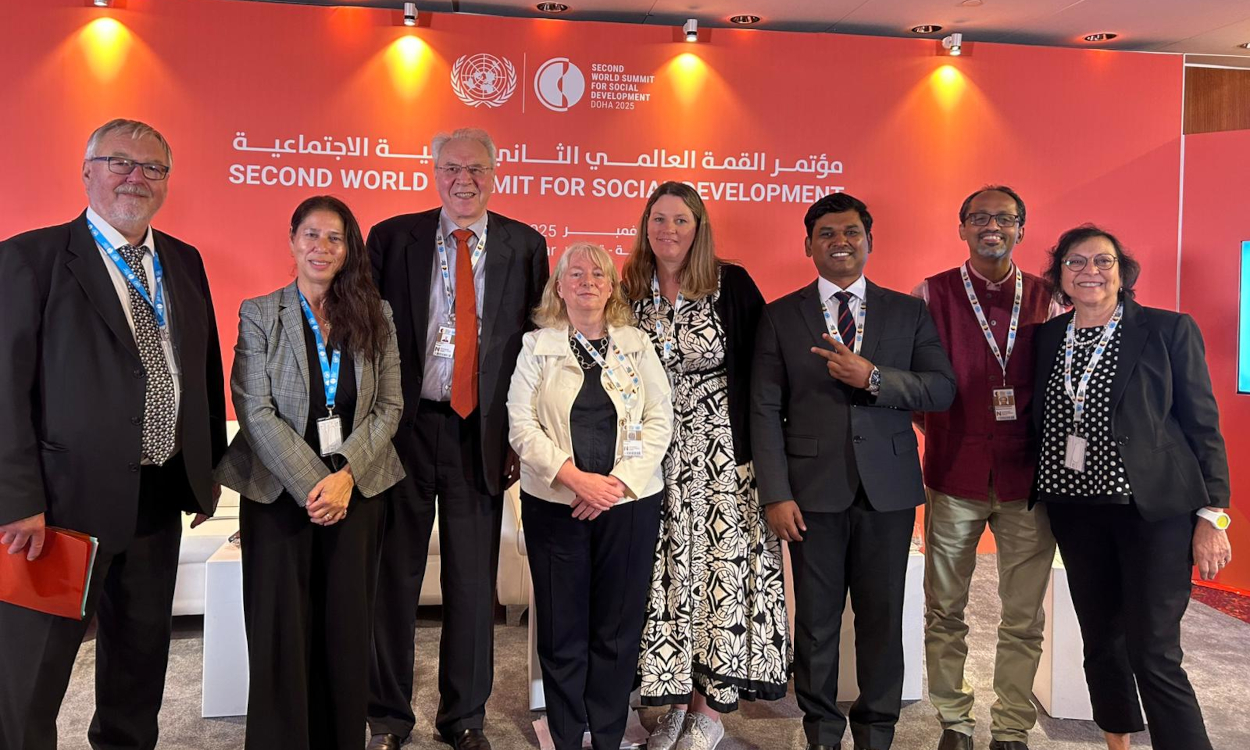
Leila Patel and Lauren Graham (ICSD/IASSW) emphasized how integrated social protection at the community level can improve outcomes for children, youth, and families, drawing on extensive evidence from South Africa. Despite long-standing global advocacy for integration, many countries still operate fragmented systems disconnected from labor markets and social services. Global actors such as the World Bank, the G20, and ICSD now call for harmonizing social assistance, social insurance, and labor programs while strengthening intersectoral coordination.
They highlighted three critical levels of integration—policy, program, and administrative—arguing that meaningful impact requires alignment across all three. South Africa’s bottom-up innovations illustrate this vividly:
- The Basic Package of Support reconnects NEET youth to education, training, and employment through personalized coaching and coordinated referrals.
- The Communities of Practice for Child Wellbeing brings together teachers, nurses, and social workers who use digital tools to assess needs and design joint interventions.
These initiatives demonstrate the importance of skilled frontline workers, trust-based collaboration, shared data, and strong local leadership. South Africa’s experience shows how community-driven integration can improve wellbeing, empower families, and accelerate progress toward the SDGs.
Sergei Zelenev (ICSW) emphasized that integrated social policy is fundamental to sustainable development, ensuring that progress in one domain does not undermine another. Integration links social protection, health, education, labor markets, and community empowerment so that economic growth translates into equitable opportunities and improved wellbeing. Integrated policies reduce fragmentation, enhance efficiency, and generate synergistic effects—such as aligning social protection with education and labor market reforms. Three priorities were identified:
- Establishing permanent inter-ministerial coordination;
- Institutionalizing participatory decision-making with communities and civil society;
- Expanding social protection to include health care, skills development, and green jobs.
Integrated social policy is presented as indispensable to realizing the 2030 Agenda and building resilient, just societies.
P.K. Shajahan (ICSW) argued that inclusive and sustainable development is possible only when marginalized communities participate meaningfully at every stage of the policy cycle. Drawing on southern epistemologies and examples from India, Africa, and Latin America, he demonstrated that locally grounded, context-specific, co-created policies enhance democratic legitimacy and reflect lived realities. Examples such as India’s Panchayati Raj and Kerala’s People’s Plan, African community-based natural resource management, informal savings groups, youth civic initiatives, and Latin American participatory budgeting illustrate how participatory governance strengthens equity and long-term sustainability. His presentation called for integrated policies linking social protection, livelihoods, and environmental stewardship, supported by institutionalized citizen forums and robust community monitoring.
Ronald Wiman (ICSW) traced the evolution of sustainable development from the 1992 Rio Declaration’s three-pillar model to a more holistic, value-based approach centered on human wellbeing. He highlighted the influence of the 1995 Copenhagen Summit, the MDGs, the financial crisis, and OECD’s inclusive growth agenda. These developments paved the way for the Wellbeing Economy model, promoted by Finland and adopted by the EU during its 2019 Presidency. Building on Erik Allardt’s HAVE, LOVE, BE, DO framework and Amartya Sen’s Development as Freedom, Wiman positioned wellbeing as the guiding purpose of policy, emphasizing people as active agents in sustainable development.
Mahesh Chougule (ICSD) examined integrated social policy through Thailand’s Community Organizations Development Institute (CODI) and the Baan Mankong housing program. These models show how linking housing upgrades with livelihood security, community finance, and participatory governance can reduce multidimensional poverty and strengthen resilience. Comparative insights from Bangkok’s canal communities and Singapore’s HDB system reinforce the value of integrating housing, health, education, and employment. Three key policy levers were identified: cross-sector coordination, participatory multi-level governance, and investment in local innovation and data-informed design.
Patricia Welch Saleeby (IFSW) stressed the need for integrated policies to advance inclusion, equity, and sustainability. She argued that social, economic, environmental, and health domains are inseparable—and that siloed systems inevitably fail those with the most complex needs. Social workers witness these intersections daily and understand how structural barriers shape individual and community wellbeing. She called for intersectoral, long-term strategies that move beyond reactive approaches to create enabling conditions for all people to thrive.
Gloria Kirwan (ICSW), moderating the session, concluded by emphasizing that the lessons presented offer valuable guidance for balancing the multiple policy pillars necessary for sustainable development and ensuring coherence across all levels of governance.


